Glass, Guts, and Glitter

What Does Success Look Like for an Artist?
You need to take the time to be genuinely honest with yourself about what you want from your art practice. It can be easy to chase someone else’s version of success, especially when the art world constantly offers us idealized markers of what achievement is supposed to look like. But not every artist wants the same life. Do you want to make functional objects, develop a commercial brand, teach, exhibit in museums, work collaboratively, or simply protect enough time to create without turning every idea into a source of income? There is no wrong answer, but there is a danger in building a practice around expectations that do not actually belong to you. Honesty gives you something essential: a clearer understanding of which opportunities will move you forward and which ones may only pull you further away from the artist, (and the life) you truly want to become.
What does being an artist look like for me, or, really, what does success look like for me as an artist?
I think this is one of the most important questions we can ask ourselves when trying to find a path through the arts, because there is no single definition of what an artistic career should be. Success can take many forms, and the life we build around our work matters just as much as the work itself.
I don’t mean that you need to immediately know which materials you love, what your aesthetic is, or exactly what you want to make. Those things take time to discover and will likely continue to evolve throughout your life. What I mean is that the art world often operates within two broad realms: the practical and the conceptual. There is a world shaped by design, purpose, function, and the needs of a consumer, and there is another shaped by ideas, emotions, questions, and beliefs.
Of course, these worlds can overlap, and some of the most compelling work exists precisely where they meet. But I do think it is important to understand which direction holds your heart and where you ultimately want your practice to lead. If you try to build a career without examining that question, the expectations of these two worlds may eventually come into conflict, leaving you at a crossroads later in your practice.
You need to take the time to be genuinely honest with yourself about what you want from your art practice. It can be easy to chase someone else’s version of success, especially when the art world constantly offers us idealized markers of what achievement is supposed to look like. But not every artist wants the same life. Do you want to make functional objects, develop a commercial brand, teach, exhibit in museums, work collaboratively, or simply protect enough time to create without turning every idea into a source of income? There is no wrong answer, but there is a danger in building a practice around expectations that do not actually belong to you. Honesty gives you something essential: a clearer understanding of which opportunities will move you forward and which ones may only pull you further away from the artist, (and the life) you truly want to become.
I say this because building a career in the arts requires an enormous amount of time, effort, persistence, and skill. You have to decide where to concentrate that energy and what kind of professional life you are actually working toward. The skills, relationships, opportunities, and financial structures needed to sustain a design-based practice can be very different from those required to sustain a conceptual studio practice.
For me, I have never been able to deny the need to create artwork that is not designed primarily for consumerism. I want to make work that causes people to feel something, work that provokes curiosity, discomfort, desire, or even confusion. Once I understood that, I also had to accept what this choice would require from me.
It meant developing a consistent studio practice, even when there was no immediate financial return. It meant becoming deeply involved in the artistic community in which I hoped to grow. Most importantly, it meant figuring out how to financially support my practice when selling the artwork itself was not always going to be the answer. (Don’t worry, I’ll get further into that in another post.)
That realization did not make the path easier, but it did make it clearer. I began to understand that success, for me, could not be measured by income alone. It also had to be measured by the depth of the work, the conversations it created, the communities I became part of, and my ability to continue building a life in which making art remained possible.
Don’t get me wrong: I still have my big-kid dreams kicking around inside me. I want to show my work all over the world. I want to become a Guggenheim Fellow. Hell, I want to fill the Guggenheim with an installation of my work! But those dreams are not the only measure of whether I have succeeded. They are destinations on a much larger path, one built through years of showing up, making difficult choices, becoming part of a community, and protecting the time and space my work requires.
For me, success is not a single achievement waiting somewhere in the distance. It is the ability to keep moving toward the artist I want to become without losing sight of why I began making art in the first place. The dream may be the Guggenheim, but the real work is building a life that allows me to keep dreaming that big.
Welcome to the Studio.
Welcome to the studio.
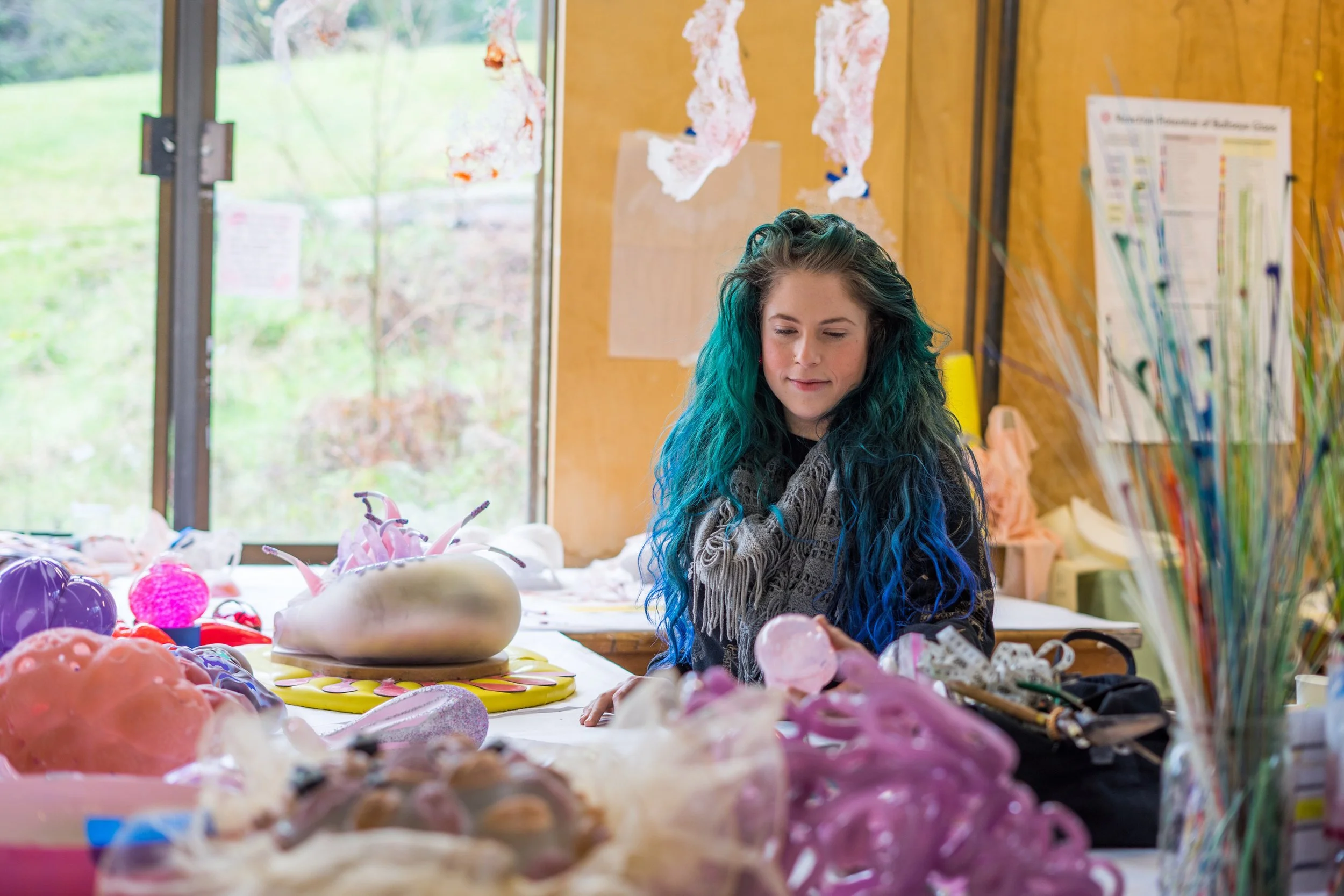
Since this is the first post, let’s start with the basics. I’m Bri Chesler, and I would describe myself as a glass and mixed-media installation artist.
I was born and raised in the swamps of Florida, believe it or not! I found art at a young age while growing up in an unsafe environment. At the time, I didn’t have the language to understand or communicate much of what I was experiencing, so art became a way of processing those emotions. In many ways, making was an act of survival. It gave me a sense of agency, a voice, and a place where I could begin to make sense of my world.
Welcome to the studio.
Since this is the first post, let’s start with the basics. I’m Bri Chesler, and I would describe myself as a glass and mixed-media installation artist.
I was born and raised in the swamps of Florida, believe it or not! I found art at a young age while growing up in an unsafe environment. At the time, I didn’t have the language to understand or communicate much of what I was experiencing, so art became a way of processing those emotions. In many ways, making was an act of survival. It gave me a sense of agency, a voice, and a place where I could begin to make sense of my world.
I was fortunate enough to attend a magnet arts program that nurtured my creative interests and eventually set me on the path toward higher education and a professional career in the arts. Along the way, one of the most important lessons I learned was that technical instruction can provide an incredible foundation, but no institution can create an artist or define their visual language. I realized that if I wanted my work to feel unmistakably my own, if I wanted to create an aesthetic and language that were immediately recognizable, I first had to give myself permission to have a voice.
Which brings me back here.
I want to use that voice to offer a little more insight into what the reality of being a professional artist actually looks like, at least for me. The life of an artist has been romanticized throughout history, and social media has created its own version of that mythology. We see finished exhibitions, beautiful studio shots, residencies, awards, and perfectly photographed objects. What we don’t see nearly as often is everything it takes to get there: the experiments that fail, the applications that get rejected, the financial gymnastics, the technical problems that make you want to rip your hair out, the ideas that sit unfinished for years, and the small breakthroughs that somehow make all of it worthwhile.
That’s what I want this space to be about.
Consider this an open door into my studio. I’ll share snippets of my thought process, works in progress, technical experiments, successes, failures, materials I’m excited about, things I wish someone had told me, and updates along the way. I don’t know exactly where this will go yet, and I think that’s part of the fun.
So, welcome to the studio. Things might get a little weird here.